There is a moment in almost every Samuel Beckett play where you realize the joke is not actually funny, and then you laugh harder because of that. The characters wait. Nothing arrives. They wait some more. The audience squirms because somewhere deep down, below the popcorn and the parking validation, they recognize the scenery.
That recognition is what existential satire does. It does not comfort you. It does not hand you a resolution or a lesson wrapped in a bow. It just holds up a slightly warped mirror and says, yes, this is the thing, and is it not ridiculous that we are all still standing here pretending otherwise.
Beckett knew it. Voltaire knew it. Twain certainly knew it, sitting on a porch in Connecticut, watching civilization congratulate itself while doing spectacularly terrible things. Kierkegaard knew it and wrote about it with such thorny seriousness that the joke almost hid. Almost.
The question people keep asking, usually in the tone of someone who has just endured a very long faculty meeting, is whether any of this still applies. We have the internet now. We have comment sections. We have an almost industrial-scale production of outrage and irony running twenty-four hours a day. Surely satire has been replaced by the real thing.
But that is exactly backwards. The noise is not a substitute for existential satire. The noise is the reason it matters more.
When everything performs absurdity loudly and constantly, the actual absurdist tradition does something different. It slows down. It gets quieter. It finds the specific, small, human moment inside the chaos and turns it over carefully in its hands. It is not trying to win an argument or rack up engagement. It is trying to tell you something true in a way that disarms you before you can throw your defenses up.
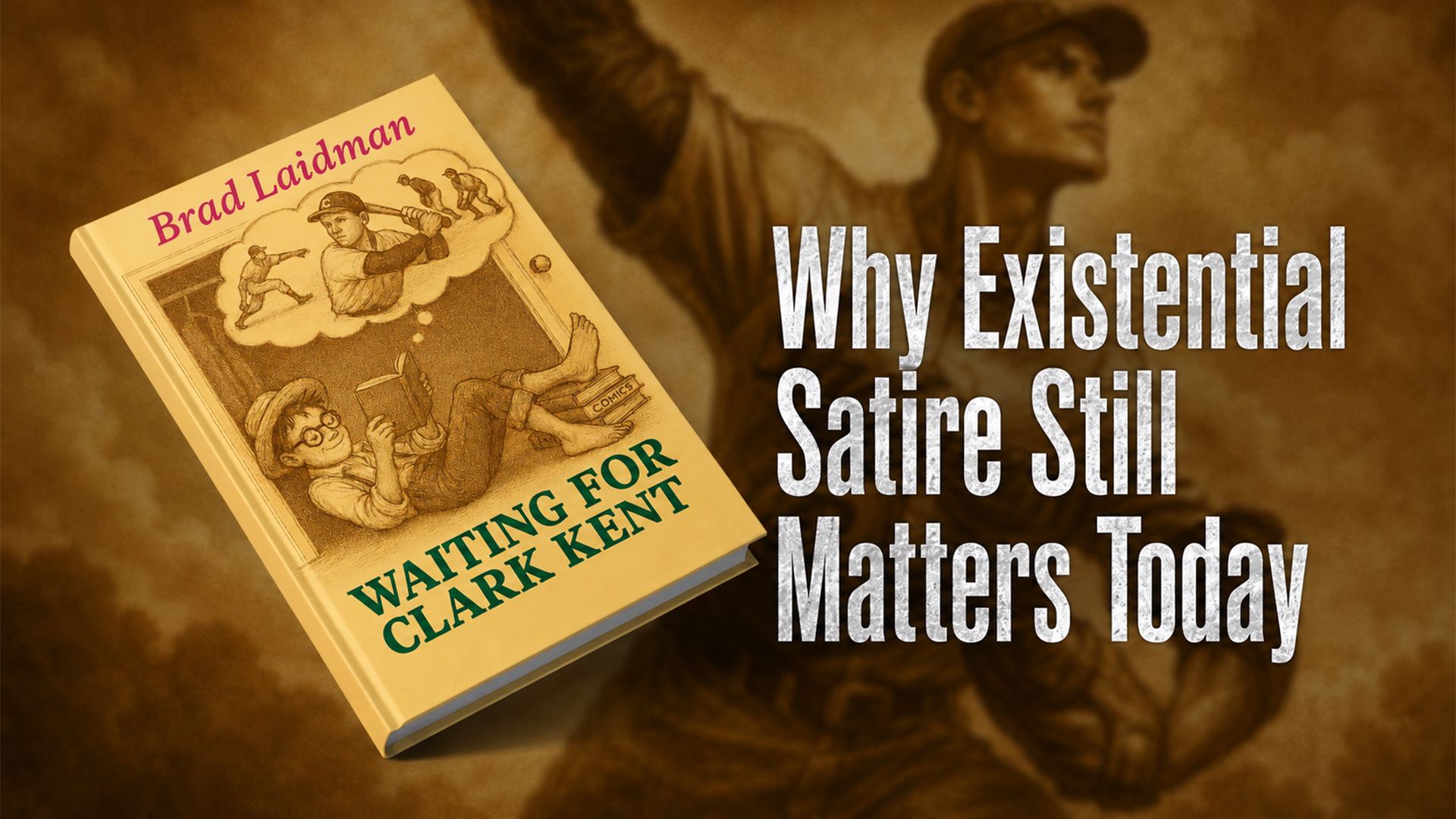
Think about what Clark Kent is, at his core, before the cape and the mythology pile on. He is a kid from nowhere who is genuinely, measurably, provably better than everyone around him at almost everything, and that does not save him from loneliness, confusion, first heartbreak, or the grinding boredom of a Tuesday afternoon in a small town. Power does not solve the interior problem. Never has. The Greeks spent thousands of years writing that same sentence in different costumes, and we are still surprised every time a famous person turns out to be quietly miserable.
Existential satire is the literary form that takes that surprise seriously instead of mocking it or monetizing it. It sits with the contradiction. Why would someone capable of anything feel so lost? Because capability is not the variable. Because the human condition has a way of remaining stubbornly itself regardless of what you can bench press or how many followers you have accumulated.
That is not a depressing observation. Or rather, it is, and also it is freeing. If Superman cannot think his way out of grief or charm his way past alienation, then maybe the rest of us are not failing by feeling those things. Maybe the goal was never resolution. Maybe the goal was just to keep moving through the labyrinth with enough humor left to notice how genuinely strange the walls are.
Satire at its best does not arrive with a prescription. It arrives with a shrug and a very precise description of the problem, delivered in a voice that makes you feel less alone for having noticed it too.
Beckett did not solve waiting. Twain did not solve human cruelty. Voltaire did not redesign the world after Candide finished his terrible journey. What they did was name things accurately and survive the naming with their wit intact.
That still matters. Honestly, right now, in this specific climate of performed certainty and algorithmic emotion, it might matter more than it has in decades. The world is not short on answers. It is very short on people willing to sit quietly with the right questions and find them, against all odds, a little bit funny.
That is the tradition. It is older than superhero movies and newer than this morning’s news cycle. And it is not going anywhere, because the thing it describes is not going anywhere either.