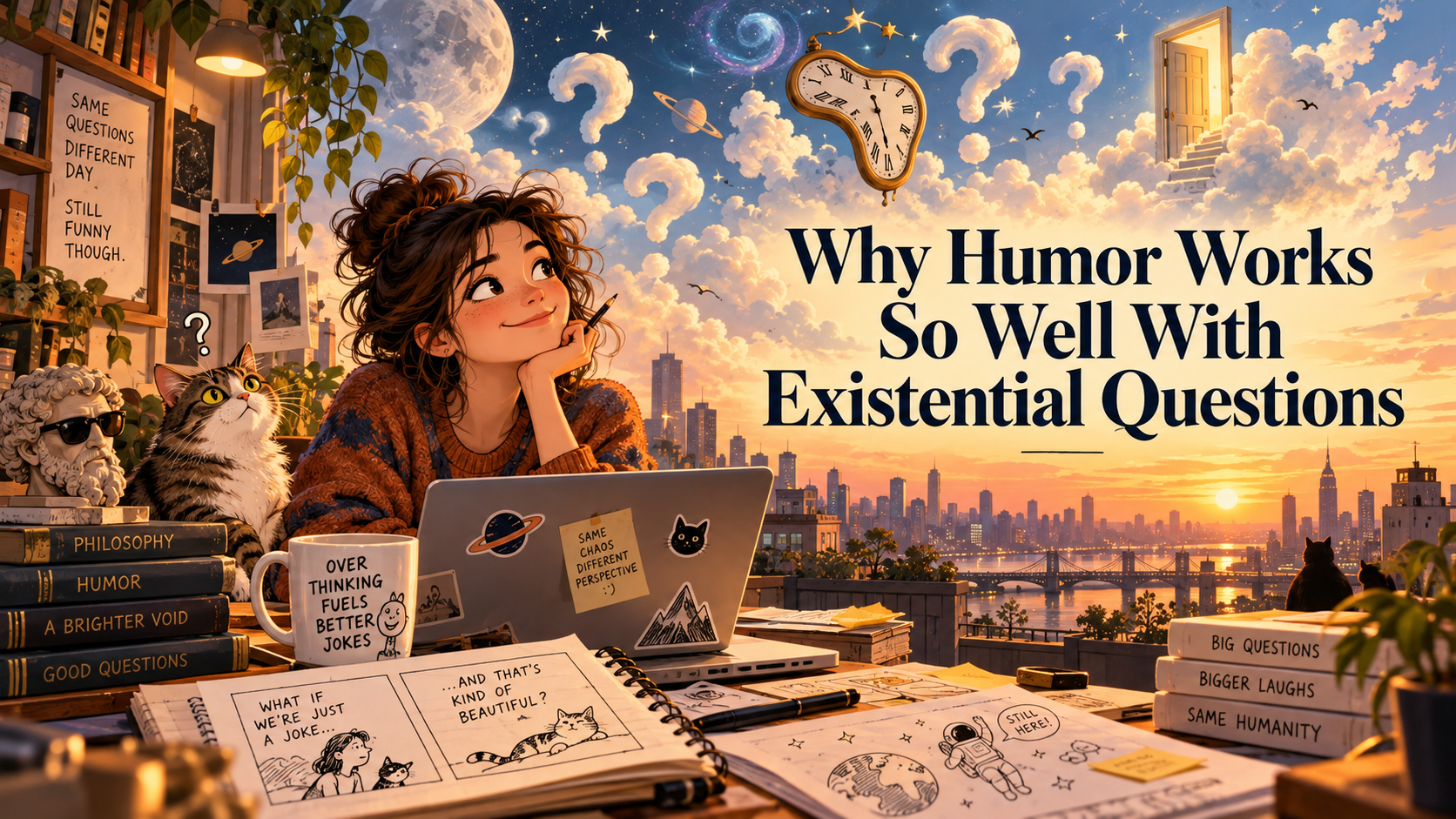
Existential questions have an innately solemn vocabulary. Topics like meaning, freedom, mortality, responsibility, and uncertainty don’t seem amenable to humor. A quiet voice, a lengthy hallway, rain on a window, and maybe a book that is impossible to read rest on their demands. Despite this, existential humor has endured for a reason seriousness can’t always achieve: it can humanize otherwise incomprehensible concepts without reducing them to a laughing matter. No amount of humor can make us immortal, create a greater good, or define our mission in life. It shifts the perspective from which we make such inquiries. Even when faced with a terrifying paradox, the mind may temporarily consider other responses.
Incongruity is the starting point for the most fundamental explanation. When an understandable expectation meets a mismatch, humor usually ensues. An absurd truth interrupts a formal social routine; an idealized self meets a realistic, unyielding body; and a person demands control before realizing the universe isn’t on board. Such inconsistencies are already prevalent in existentialist philosophy. In a world where everything is always changing, people nevertheless look for consistent meaning. They spend a lot of time winging it, but they always try to present themselves as well-developed heroes. In their pursuit of autonomy, they want the assurance that someone else can make the right decisions for them. Observing and shaping these tensions is what comedy is all about.
This does not suggest that existential humor alleviates suffering. No matter how existential humor the subject matter is, the utmost seriousness is maintained. Without implying that absurdity is enjoyable, it allows the audience or reader to experience the absurdity of the situation. It is possible to feel real loss while also laughing at the pointlessness of attempting to influence every possible result. In reality, the familiarity of the contradiction brought on by sadness and worry likely makes laughing possible. Laughter is not a defense of meaninglessness. Often, it’s a way of saying that the really important things can’t be handled with the typical polite terminology.
This sits near the philosophical borderline between the completely unbelievable and the just plain ludicrous. The absurd is a case of a little slip-up: the incorrect headgear, the delayed response, the peeled banana. When people’s expectations of the world collide with their need for consistency, the result is absurdity. Between the two extremes, existential humor swings in between. It uses a local shame to bring the cosmic subject into view. Examples of what may happen in a story include characters getting stuck in bureaucratic red tape, arguing with a useless machine, making a dramatic speech in front of a vacant room, or realizing that a claimed destiny was set for the wrong day. After chuckling at the moment, viewers see the bigger picture it conveys.
Because they bring ideas to light, cartoons and satire are powerful tools. Internal monologue is one way that alienation is shown in traditional realism stories. In a cartoon, feelings of isolation may be symbolized by a figure pulling a hole in the ground or by an office where every door leads back to the same workstation. The impossible picture helps the spectator conceptualize more quickly. It turns an intangible emotional framework into something tangible that can be examined, evaluated, and mocked. This way of thinking is not inferior. Exaggeration, rather than definition, is the means of arrival in this visual argument.
Humor also creates a little but significant separation. When faced with an existential humor crisis, the question might seem all-encompassing, as if there is no way out, no other viewpoint, and no words to describe how one feels except despair or hopelessness. Comics break apart that whole. The punchline rearranges the scene and draws attention to the extra frame. Perhaps the solemn authority is being too formal. Maybe the narrator is being dramatically egotistical in his misery. A ridiculously small number of facts may have led to the purportedly final decision. Instead of rendering the question useless, this new perspective keeps it from becoming a tyrant.
The societal effects of such a trait are real. Suspicion of being unusually odd, terrified, or incapable of accepting the scripts that comfort everyone else might aggravate existential distress. Contradicting that seclusion is shared laughter. It isn’t an automatic way to create closeness, and it may be nasty when used on someone who is weak. But when jokes target real problems instead of scapegoats, they show that the paradox is obvious. Simply because one person is stupid doesn’t make the rest of the audience laugh. It makes light of the issue by showing something universally human: everyone needs a map, and every once in a while, someone finds out the map is on a serviette from a restaurant that closed down.
To achieve this impact, writers use a variety of approaches. One is scale inversion. Someone in the story may handle a metaphysical disaster with the undivided attention of an email responder, or see a minor annoyance as a major problem. Literalism is another. A person’s emotional baggage becomes as ubiquitous as a suitcase in every discussion. Anticlimax is another. Hunger, poor timing, or an administrative form stops the character as they build toward a climactic reveal. These methods work because they highlight the chasm between humans’ lofty ideals and the obstinately material reality of everyday existence. That ambition is naive is not the punchline. Aspiration, the joke goes, can’t function apart from other people, schedules, and institutions.
The tradition’s literary history is extensive. Because of the comedic and bleak nature of waiting, repetition, and broken communication, Samuel Beckett’s work is often cited. More than just one author or school, the underlying notion is universal. A character’s capacity to see the precariousness of a societal position, an inherited belief system, or a personal aspiration opens the door to comedic possibilities in any work. The comedic tone might range from mild to macabre, from deadpan to raunchy, or even otherworldly. Rather than sharing a common aesthetic, these forms are linked by a shared intellectual trajectory: the realization that what was once taken for granted as natural is, in reality, contingent and thus open to scrutiny.
Limits exist in terms of ethics. When existential humor uses another person’s actual pain as a joke for dramatic effect, it loses its power. When making a joke about death, disease, injustice, or violence, it’s important to consider proximity, context, and power. It matters whether the humor mocks the system that caused the injury or simply laughs at it from a distance. Comedy at its finest does not demand that its viewers lose their feelings. A more observant audience is requested. Because it does not conflate harshness with honesty, it can pierce pretense, false assurance, and denial.
The story Waiting for Clark Kent shows how this strategy might be useful. The novel raises important issues like power, solitude, and responsibility, despite its comedic and cartoonish tone. In this way, such questions remain open. As the reader can see, asking a single extraordinary individual to fix a whole culture’s moral contradictions is ridiculous. Humor is a defense mechanism against idolatry. This lets the book challenge heroic myth without denying the tale’s imaginative power. Striking that balance is challenging because cynicism kills wonder and sentimentality dodges criticism. Both can coexist in existential humor. The point of this humor isn’t to make people laugh out loud, but to keep their attention. A humorous remark might lighten the mood sufficiently to consider an unpleasant idea. When fatalism sees only a wall, it might reveal a hidden alternative. It may reveal how irrational a worry is without downplaying its emotional validity. Humility may be its greatest benefit. Despite our frailty, confusion, and idiocy, we humans are nonetheless full of compassion, bravery, and creativity. Mirth cannot resolve the existential dilemma. Nonetheless, it might be a compassionate method to stay in the now while living there.