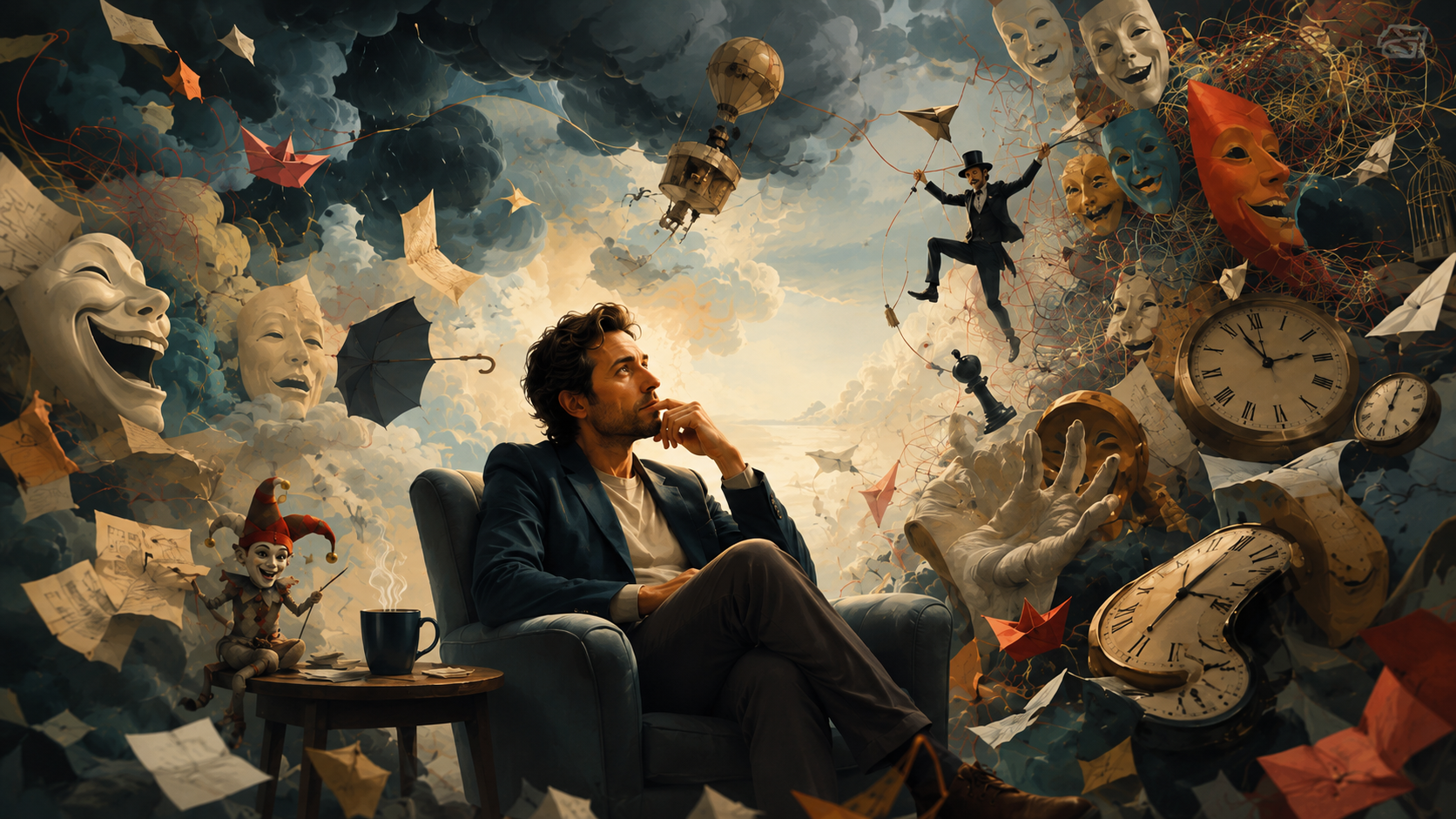
The world has always been chaotic. We just have better cameras now.
Every collapse arrives in high definition. Every foolish remark is clipped, captioned, reposted, debated, monetized, and eventually turned into a mug. The modern adult is expected to absorb all of this calmly while answering emails, remembering passwords, buying groceries, pretending to understand insurance, and maintaining a healthy relationship with sleep.
Under these conditions, satire is not a luxury. It is one of the few remaining ways to look directly at reality without allowing reality to sit on your chest.
Satire gives us distance, but not escape. It lets us step half a pace away from the disaster and notice that the emperor is not only naked but has hired a branding consultant to describe the nudity as strategic transparency.
That half-step matters.
Satire Says What Polite Language Cannot
Serious language has its place. We need facts, testimony, history, and honest argument. But serious language can also become trapped inside institutions that have learned how to survive criticism.
Public figures apologize without admitting fault. Companies announce “difficult decisions” that are usually difficult for someone else. Leaders describe confusion as complexity and failure as an evolving opportunity. The words become smooth enough to skate on.
Satire pours sand on the ice.
It takes inflated language and returns it to human scale. It asks rude questions. It points out when a noble speech sounds suspiciously like a sales pitch written by a committee. It reminds us that pomp is often fear wearing a rented tuxedo.
Adults need this because adulthood comes with an exhausting amount of officially approved nonsense. We are told to be realistic by people selling fantasies, authentic by algorithms, and peaceful by companies sending twelve notifications before breakfast.
Satire does not solve these contradictions. It refuses to pretend they are normal.
Laughter Is Not the Same as Indifference
Some people distrust jokes during difficult times. They worry that humor makes suffering seem trivial.
Bad humor can do that. Cruel humor punches downward, turns pain into spectacle, and calls the result bravery. Satire at its best exposes the structures, habits, vanities, and lies surrounding the pain.
A good satirist is not saying, “Nothing matters.” The message is closer to, “This matters so much that the official explanation has become unbearable.”
Mark Twain did not mock human stupidity because he hated humanity. He mocked it because stupidity becomes dangerous when dressed as certainty. Voltaire did not laugh because life was painless. He laughed because pain surrounded by solemn hypocrisy is somehow worse.
Real satire contains anger, but also disappointment. Beneath the joke is the bruised belief that people might behave better if they could see how ridiculous they look.
That belief is oddly hopeful.
Chaos Makes Everyone Vulnerable to Grand Stories
When life feels unstable, people become hungry for simple explanations.
Someone must be entirely guilty. Someone else must be entirely pure. History must be moving toward a guaranteed ending. A strong person must arrive, fix everything, and pose against the sunset while the orchestra handles the emotional paperwork.
We have always loved these stories. Superheroes did not invent the fantasy of rescue. They simply improved the wardrobe.
But power does not remove confusion. It often enlarges it.
Imagine being stronger than everyone around you and still unable to understand why people lie, leave, betray, grieve, or vote for someone who appears to have lost an argument with a necktie.
The interesting question is not whether Superman can lift the building. It is whether lifting the building teaches him anything about loneliness.
Satire pokes holes in grand stories. It asks what happens after the hero wins. Who fills out the paperwork? Who repairs the street? Does the rescued city become wiser, or does it immediately complain about property taxes?
The joke restores complexity. Complexity is annoying, but it is usually where the truth is hiding.
Satire Helps Us Recognize Ourselves
It is easy to enjoy satire aimed at other people.
The politician is vain. The celebrity is shallow. The billionaire is detached. The neighbor has installed a lawn sign with enough text to qualify as a minor Russian novel.
Then the joke turns and catches us in the frame.
We also perform. We exaggerate. We defend ideas because abandoning them would make last Tuesday embarrassing. We complain about technology while checking our phones during the complaint. We want honesty, provided it arrives gently and agrees with us.
Useful satire does not permit the audience to remain innocent.
By adulthood, most of us have constructed a flattering internal biography. We are the reasonable one, the hardworking one, the misunderstood one, the person who would have behaved courageously in every historical crisis despite becoming irritated when a coffee order takes six minutes.
Satire introduces evidence for the prosecution.
Not to destroy us. To make us less certain, and possibly less dangerous.
It Keeps Despair from Becoming a Religion
Chaos can turn despair into a kind of sophistication. Cynicism begins to feel intelligent because hope has embarrassing shoes.
Satire occupies healthier territory between denial and surrender. It admits that systems fail, people disappoint, power corrupts, and history repeats itself with minor costume changes. Then it finds something absurd enough to laugh at.
That laugh is not victory. It is resistance.
It means chaos has not completely dictated the conversation. Fear and grief may be present, and the future may look as though it was assembled from spare parts in a dim garage. Still, the mind can transform confusion into a joke, and the joke into recognition.
We laugh because we see it. We see it because, for a moment, we are no longer trapped entirely inside it.
Adults do not need satire to avoid reality. We need it to remain awake within reality—when language becomes dishonest, power becomes theatrical, certainty becomes fashionable, and despair begins selling itself as wisdom.
The world may remain chaotic. Most likely it will. Human beings have survived plagues, wars, empires, depressions, disco, and several cinematic attempts to explain Batman’s childhood.
We are still here.
Not improved beyond recognition, perhaps. But still capable of laughter, which is sometimes the sound a mind makes when it refuses to surrender.