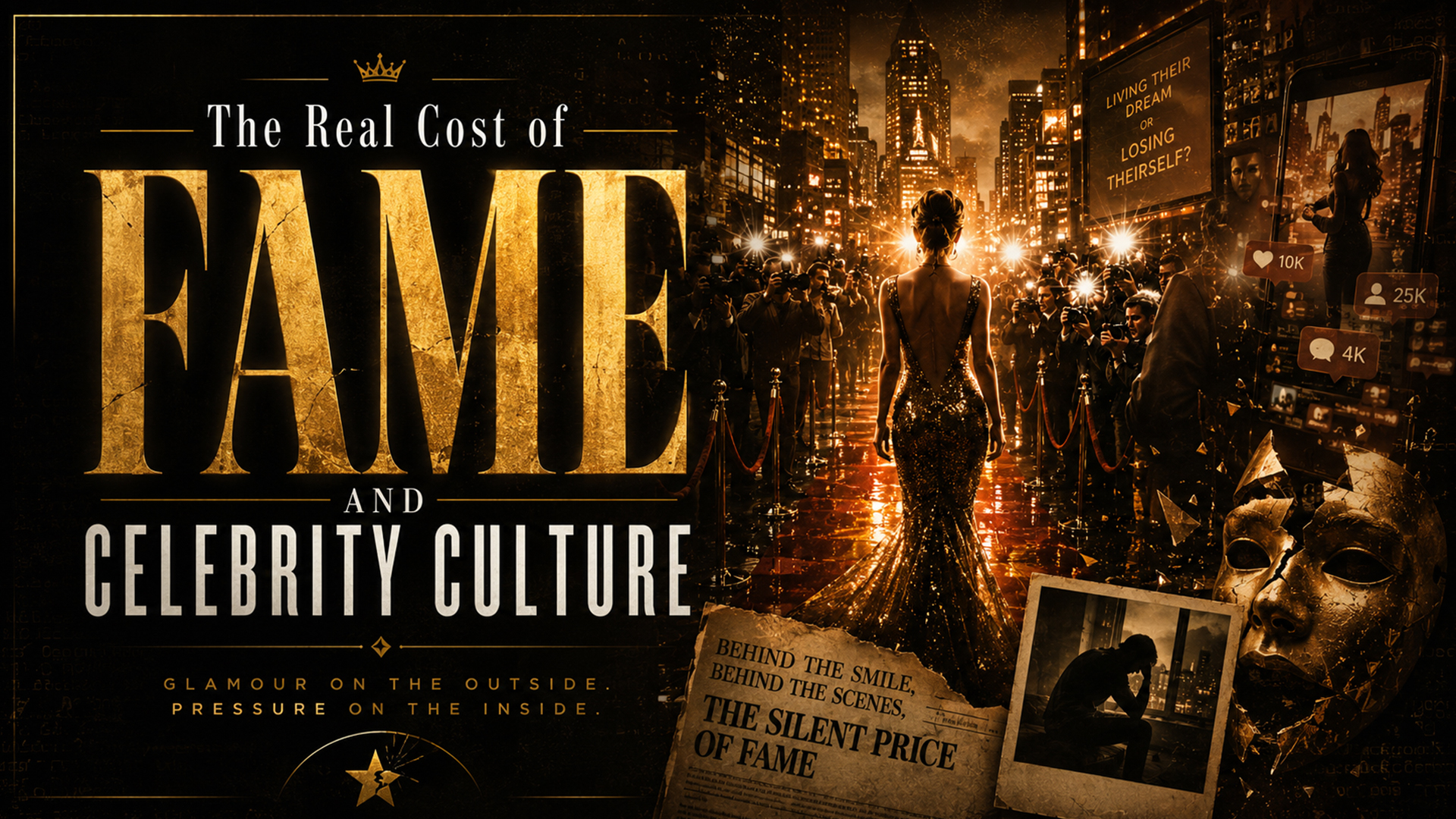
Fame has always been sold as a reward. Work hard enough, become talented enough, attractive enough, successful enough, and eventually the world notices. It is one of the oldest promises in human civilization. Ancient warriors chased glory. Poets wanted immortality. Kings built monuments. Today there are reality television shows, social media platforms, and an endless parade of influencers documenting lunch as though future archaeologists will desperately need the evidence.
The packaging changes. The dream remains remarkably consistent.
The strange thing is that fame often looks far better from a distance than it does up close.
A person can spend years imagining what it would be like to be recognized everywhere, only to discover that recognition and understanding are not remotely the same thing. One brings attention. The other brings connection. Human beings frequently confuse the two.
Celebrity culture has become a curious form of modern mythology. Instead of telling stories about gods descending from Mount Olympus, society follows actors, athletes, musicians, internet personalities, and public figures whose lives are transformed into ongoing narratives. Every triumph becomes a headline. Every mistake becomes public property. Entire industries now exist to analyze facial expressions, social media posts, and relationships between people most observers will never meet.
The level of interest would seem absurd if it were not so common.
Millions of people know intimate details about celebrities while remaining strangers to the individuals living three houses away. Entire afternoons disappear into discussions about public figures whose existence has little direct impact on everyday life. Yet the fascination persists because celebrity has never really been about the celebrity. It has always been about the audience.
Famous people become containers for collective hopes and frustrations. One celebrity represents success. Another represents rebellion. Another becomes a symbol of beauty, intelligence, wealth, power, or freedom. The public often turns human beings into symbols long before realizing that symbols have an unfortunate tendency to remain human.
That realization can be disappointing.
The athlete eventually grows older. The actor chooses the wrong role. The musician says something foolish. The internet star discovers that performing a personality for millions of people every day can become exhausting. Audiences act surprised each time this happens, as though fame somehow grants immunity from confusion, insecurity, boredom, or poor judgment.
History repeatedly demonstrates otherwise.
Some of the most celebrated individuals who ever lived spent enormous portions of their lives unhappy, restless, lonely, or dissatisfied. Success solved certain problems while creating entirely new ones. Wealth offered comfort. It did not necessarily offer peace. Admiration provided validation. It did not automatically create meaning.
The contradiction sits at the center of celebrity culture. Society treats fame as proof that someone has reached the destination while many famous individuals quietly discover there is no destination at all.
The finish line keeps moving.
Perhaps that explains why stories about superheroes remain strangely relevant. Beneath the costumes and impossible abilities, many superhero stories revolve around the same tension. Extraordinary people often find themselves wrestling with ordinary human concerns. Loneliness, identity, belonging, disappointment, first love, failure, grief, uncertainty—none of these disappear simply because someone can fly.
In many ways, the most unrealistic aspect of superhero fiction is not the superpowers. It is the assumption that immense power would simplify life.
Most evidence points in the opposite direction.
The modern celebrity faces a similar dilemma. The larger the public image becomes, the harder it can be to preserve a private self. Millions may recognize a face while knowing almost nothing about the person behind it. Applause fills arenas. It does not necessarily fill empty spaces in a life.
That truth is less glamorous than the fantasy being sold, but it is probably more useful.
Fame can be wonderful. Success can be rewarding. Recognition earned through talent and hard work deserves admiration. None of those things are the problem. The problem begins when fame is mistaken for fulfillment or celebrity is confused with significance.
Human beings have chased status for thousands of years because they hope it will answer questions that status was never designed to answer.
Who am I?
Where do I belong?
What matters?
How should a life be lived?
Those questions remain stubbornly immune to applause.
The spotlight can make a person larger in the public imagination. It cannot make them less human. In the end, that may be the real cost of fame. The world starts treating someone like a symbol at precisely the moment they are still trying to figure out what it means to be a person.