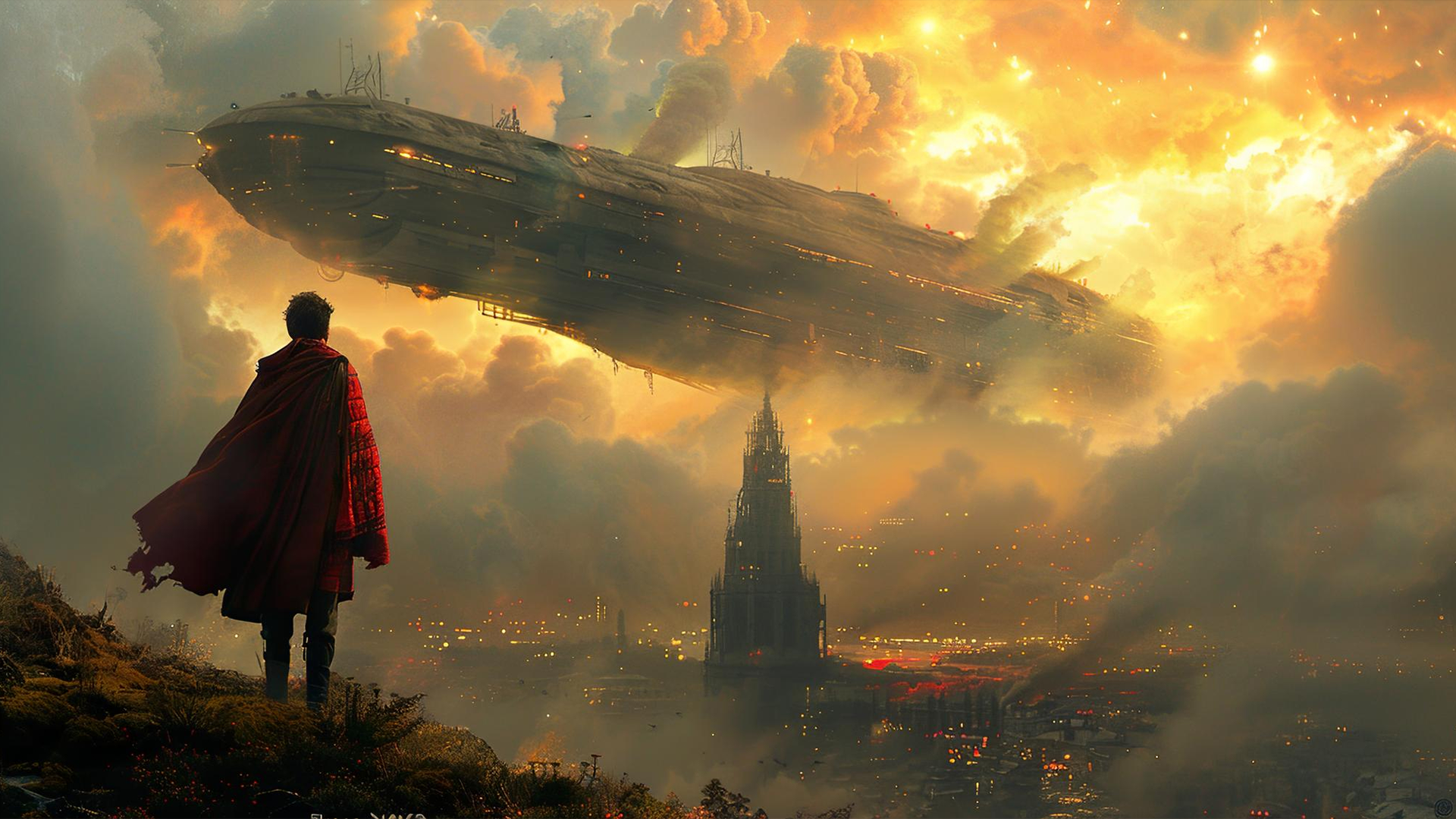
People call Superman simple, which has always seemed like a strange diagnosis. It is a little like calling the ocean damp or saying Hamlet just needed better time management.
From a distance, maybe he looks simple. Cape. Boots. Farm-boy decency. A square jaw so reassuring it could probably calm livestock. But then the premise starts unfolding and the whole thing turns gloriously unstable. A child is fired out of a dying world, lands in Kansas, grows up polite, discovers he can hear disaster from miles away, and is somehow expected to move through life as if this is emotionally reasonable. That is not simplicity. That is the existential theater of the absurd in red boots.
The version of Superman that lasts is never the polished saint floating above the rest of us like a moral weather balloon. It is the stranger one. The sadder one. The one who understands, even if only dimly, that being powerful does not make existence any less weird. Maybe we have spent too much time treating him like a civic monument and not enough time admitting that he is also a cosmic joke told with a straight face. Voltaire would have enjoyed the satire of it. Vonnegut would have recognized the grief under the punchline. Beckett, Ionesco, Jarry, they all would have known what to do with a man who can move mountains and still cannot solve the basic embarrassment of being alive.
That is the Superman worth thinking about.
Too powerful for the little things and helpless before the big ones
His real problem is not power. His real problem is that power is useless against the questions that actually ruin a person.
It cannot tell him who he is. It cannot settle the quiet panic of not quite belonging. It cannot explain love, or loneliness, or why destiny always sounds majestic until it starts interfering with your afternoon. He can stop a train, sure. Wonderful. Applause all around. But that does not help much with grief, identity, longing, boredom, or the persistent humiliation of having a soul.
That is where he stops being a symbol and starts being a character. Not because he is ordinary. He is not ordinary in any useful sense. He is absurdly gifted, embarrassingly overequipped, a walking violation of proportion. But human beings understand something about carrying too much inside themselves while trying to look manageable on the outside. We understand disguise. We understand self-editing. We understand walking into a room and deciding, in real time, how much of the truth people can bear.
Clark Kent is not just hiding. He is translating. He is reducing the voltage. He is shaving off the more alarming edges of himself so other people do not have to confront the unsettling fact that the nice guy in glasses is basically a myth with posture problems.
There is comedy in that, and there should be. It is wickedly funny, really. A near-god fumbling with tone, posture, and eyewear so he can pass as harmless. But the joke works because it shares a wall with sadness. That is the trick. The laughter and the ache are roommates.
More absurd than inspirational
People tend to flatten comic books into either nostalgia or spectacle, as if those are the only shelves available. But comic books, in the right hands, can do something stranger. They can get at the same nervous truth the absurdists did. They can take a premise that sounds ridiculous and use it to expose how ridiculous ordinary life already is.
That is Superman’s territory when he is written well.
He is not just heroic. He is existential. He is a man from a dead planet trying to behave normally in a world that keeps asking him to be a symbol, a savior, a son, a boyfriend, an idea, a fantasy, and occasionally office staff. The joke is not added afterward. The joke is built into the structure. He is too much for the world and still has to participate in it. He has cosmic scale and everyday obligations. He can hear the screams of the planet and still has to stand in kitchens, hallways, parking lots, and conversations pretending things are not completely insane.
That is funny in the way Beckett is funny. Funny because the alternative is collapse.
And that is where the Vonnegut air comes in too, that sly understanding that sorrow often arrives wearing clown shoes. Superman needs that atmosphere around him. Without it, he becomes pious. With it, he becomes human, or at least human-adjacent in the only way that matters. A little tired. A little baffled. Slightly offended by his own mythology.
The lonely alien part is not decoration
The alien heritage is not there to make him grander. It is there to make him lonelier.
He is the survivor of a vanished world. The remainder of a catastrophe. The child of one reality being raised inside another. So even in the warmest versions of the story, even with Kansas, even with love, there is always that distance. That private frost. He belongs and does not belong at the same time. He is home and in exile. He is loved and still separate.
That split is the engine.
It keeps him from turning into a mascot. It gives the whole thing its bruise. He is not just a fantasy of power. He is a fantasy of estrangement. A person can be admired and still feel outside the room. A person can be shaped by love and still carry some untranslatable sadness around like hidden contraband. Superman works because no victory solves that. No act of goodness makes him less displaced.
And he should not look too comfortable in the role. That is part of what makes him interesting. Legends are what other people call your damage when they do not have to carry it. The better Superman stories understand that he is not glowing with certainty. He is often just doing his best while trapped inside a premise that would make a normal person laugh for ten minutes and then lie down in the dark.
A grown-up book built from young bones
What is especially good here is that the story does not reject the young reader in order to become sophisticated. It grows out of that earlier world.
You can feel the young adult DNA in it. The lonely gifted kid. The suspicion that you are different before you know how. The sense that the world is asking something huge from you before you have even figured out your own face. Those feelings belong to childhood and adolescence. They belong to comic books and first obsessions and dog-eared stories read under bad light.
But then the material matures without losing its cartoon outline. It becomes adult without becoming dead on the page. The themes deepen. The weather changes. Irony comes in. Alienation comes in. Desire, grief, disappointment, absurdity, the long strange joke of trying to become a person while carrying an impossible identity. It becomes a sophisticated cartoon in the best sense. Children laugh at one set of things. Adults laugh at another. Then the children grow older and realize the deeper joke had been there all along, waiting patiently for them to catch up.
That delayed understanding is part of the beauty of it. It means the book keeps opening. It trusts the reader. It lets innocence and damage occupy the same bright frame.
Which is why the old divide between “serious literature” and comic-book imagination has always seemed silly to begin with. Sometimes the most serious work is the one brave enough to look ridiculous. Sometimes the costume is what lets the truth in.
So is Superman an existential hero or just a lonely alien
Both, or he is not much of anything.
He is existential because he keeps acting without ever receiving a clean explanation for himself. He is lonely because no amount of love can entirely erase the fact that he comes from elsewhere and carries that elsewhere inside him like a second skeleton. He is funny because his situation is funny. He is sad because his situation is sad. That is not a contradiction. That is the electricity of the whole thing.
Take away the absurdity and you lose the wit. Take away the loneliness and you lose the wound. Take away the humor and the story hardens into piety.
What keeps Superman alive is the impossible mixture. The childish silhouette carrying adult sorrow. The cosmic joke delivered in perfect sincerity. The sense that beneath all the power there is still someone trying to understand why being extraordinary does not make life any easier to interpret.
Not a saint, then. Not a mascot. Not a polished answer.
Just a lonely alien with excellent posture, trying to survive the absurd with some decency intact.